Data centers in the United States: technological prosperity or social divide?

This analysis was produced by trickstr AI (https://trickstr.ai/) from its proprietary knowledge graph and stakeholder OS. This is an export of an intelligence report in article form; an interactive version is available on request. Stakeholders covered: political actors, institutions and regulators, companies, and media. Data scope: United States, from 10/25/2025 to 04/30/2026, social media publications and online press articles.
The U.S. data center market, driven by an insatiable demand for artificial intelligence and cloud computing, is the stage of an expansion of unprecedented scale and speed. Carried by colossal investments from the hyperscalers — Amazon, Google, Microsoft, Meta — and from new specialized players, this race for compute power is reshaping the industrial and energy landscape of the United States. This boom is presented by its proponents as an imperative of national competitiveness, an engine of local economic growth, and the indispensable foundation of the next technological revolution.
However, this optimistic narrative is meeting growing opposition that is multiform and deeply rooted in local territories. Local communities in 24 states are mobilizing against projects deemed excessive, denouncing an unchecked consumption of energy and water resources, environmental nuisances, and a financial burden unjustly shifted onto citizens. This report sets out to analyze this polarization through the media and political prism. The aim is to decipher how the expansion of data centers, far from being a mere technical issue, has become a powerful indicator of the fractures of contemporary America, pitting the promise of technological sovereignty against the reality of local impacts and raising a fundamental question: who should pay the price, financial and environmental, of the AI revolution?
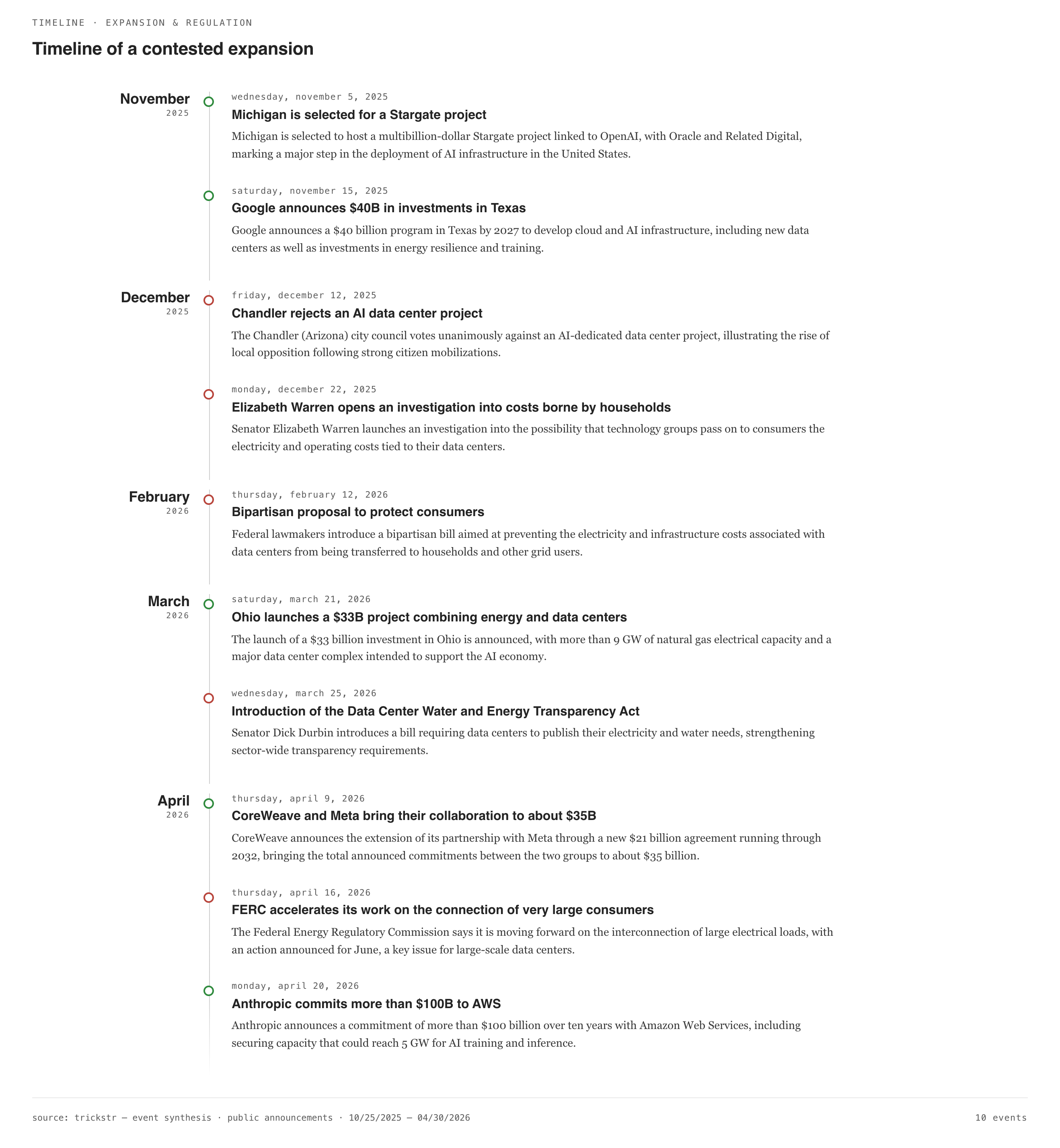
Timeline of a contested expansion
The dynamics of the sector are marked by a succession of investment announcements of several tens of billions of dollars, but also by an intensification of political and citizen actions aimed at regulating their impacts. This timeline illustrates the duality of a sector in full growth but increasingly under scrutiny.
A media battlefield marked by sharp polarization
The analysis of media coverage reveals a deeply polarized debate. Across the 37 media outlets analyzed, the treatment of the topic swings violently between radically opposed visions, with weak representation of moderate positions.
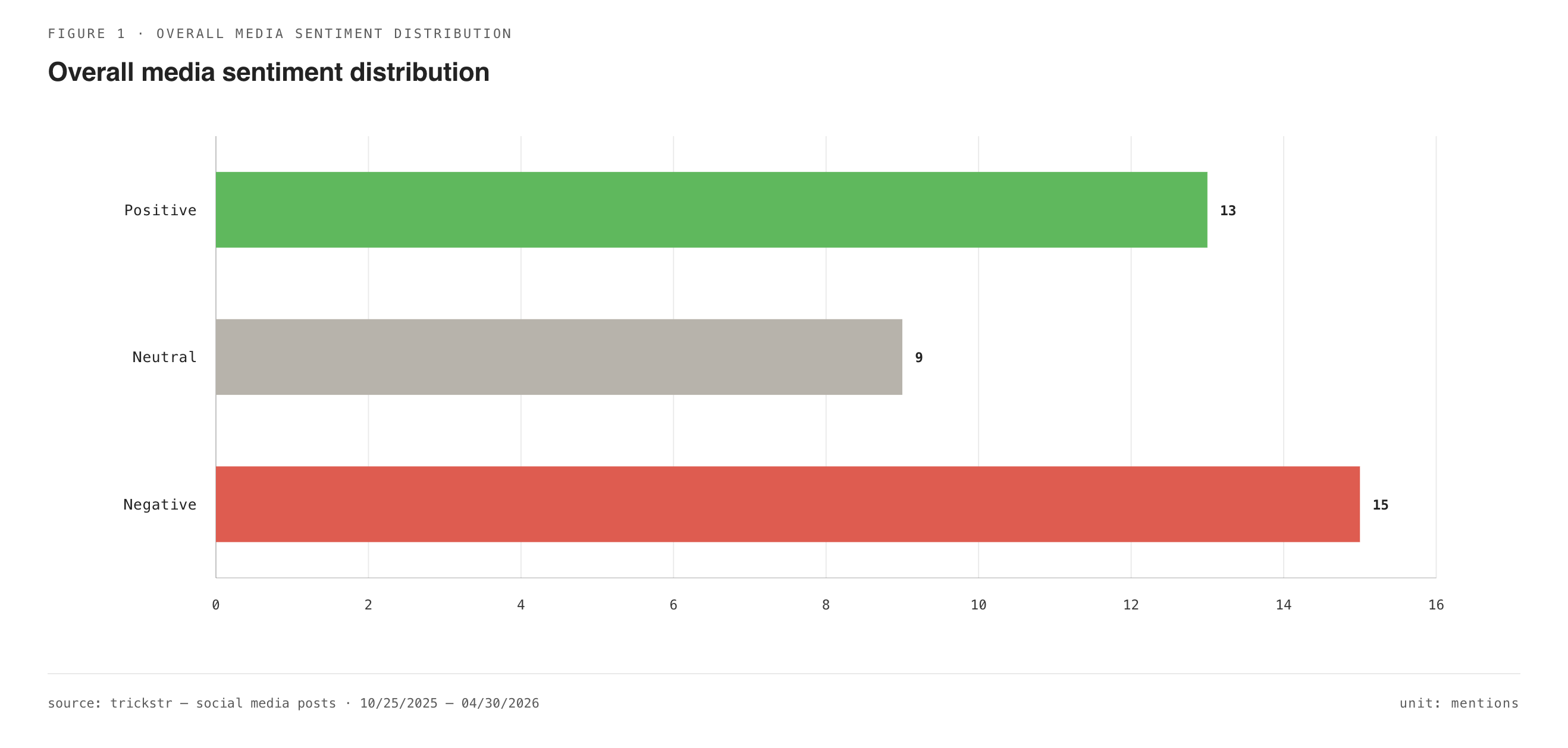
Nearly 38 % of outlets adopt a very negative tone, highlighting local conflicts, environmental costs, and pressures on electrical grids. At the opposite end, about 22 % of publications are very positive, focusing on investments, technological innovation, and economic competitiveness. This polarization is even sharper when analyzed through the prism of the political orientation of the outlets.
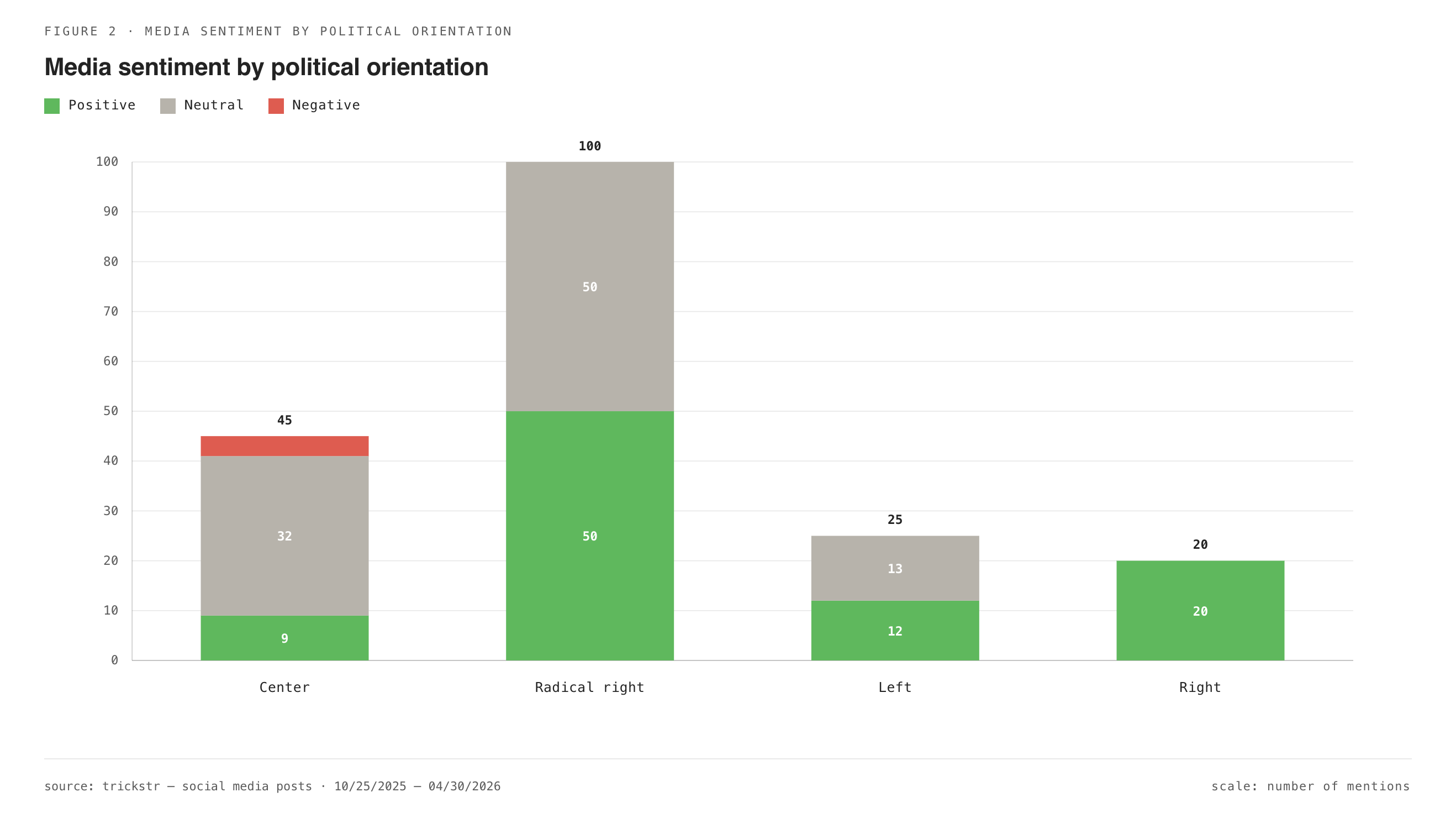
Of the 141 political figures who reacted, the vast majority sit on the right (57 %) or on the left (41 %), with an almost nonexistent center presence. The analysis of their respective sentiments confirms this head-on opposition.
- Right-leaning media cover the topic in an almost unanimously positive manner (80 % very positive, 20 % positive), insisting on the role of data centers as a driver of the economy, of employment, and of American technological supremacy.
- Left-leaning media adopt a largely critical stance, with 75 % of articles in a very negative tone, echoing environmental concerns, costs to consumers, and criticism of subsidies granted to tech giants.
- Centrist media present a more fragmented but tendentially negative landscape (36 % very negative), reflecting both the economic promises and the local controversies.
Leading press outlets such as the Washington Post (-0.57) and influential local media such as the Atlanta Journal-Constitution (-0.36) or The Baltimore Sun (-0.71) have largely echoed local opposition and negative impacts. Conversely, networks such as Newsmax TV (+0.50) or newspapers such as the Wall Street Journal (+0.33) and the New York Post (+0.50) relay a pro-business vision, valuing investments and growth.
The political arena: a clear partisan rift
The data center controversy has quickly moved into the political field, where it reveals a near-perfect partisan divide, particularly at the federal level. While local opposition is described as bipartisan, statements from national elected officials show a strong correlation between political affiliation and positioning on the topic.
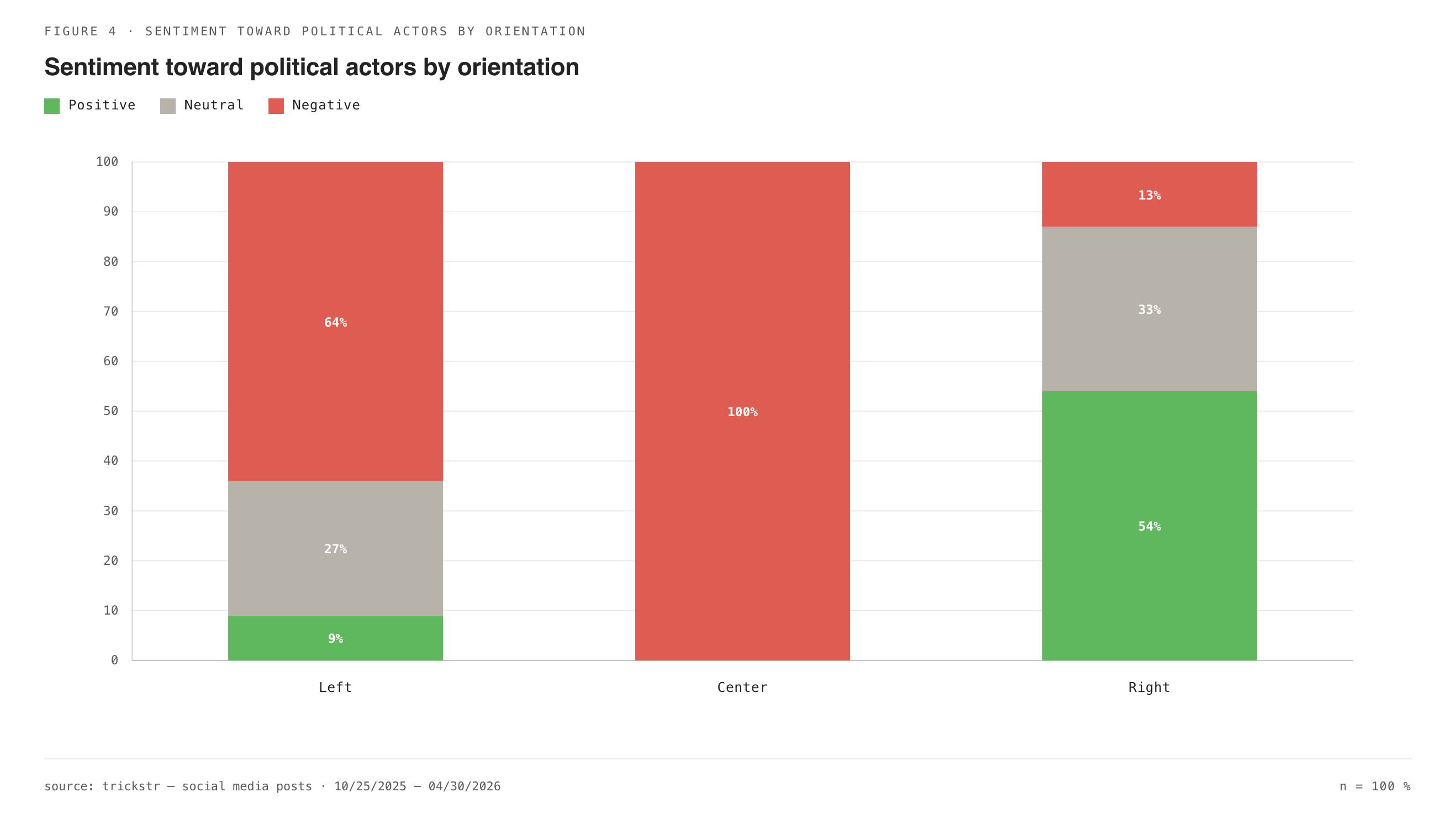
- Republican and right-wing officials massively support data center development (54 % positive sentiment). Their discourse revolves around energy sovereignty, competitiveness against China, and lower costs for businesses. Senator Ted Cruz, for example, shared an analysis showing much lower electricity prices in the “red states” thanks to pro-business policies, implicitly linking industrial development to this vision. Chris Wright, a member of the administration, hammers home that “unleashing nuclear energy is how we will power American artificial intelligence.”
- Democratic and left-wing officials express overwhelming opposition (64 % negative sentiment). Their criticisms focus on the rise in household electricity bills, the environmental impact, and tax advantages deemed undue. Senator Elizabeth Warren has launched an investigation into the possibility that tech giants “make consumers pay the construction and operating costs of their data centers.” Representative Mike Levin denounced the fact that the administration “uses your tax dollars to make your energy bills more expensive” by blocking renewable alternatives.
This rift is also found in legislative initiatives. Democrats such as Senator Dick Durbin have introduced bills to require more transparency on water and energy consumption (Data Center Water and Energy Transparency Act), while figures such as Alexandria Ocasio-Cortez have applauded the rejection of projects by city councils.
Corporate and institutional narratives: promoting technological inevitability
Faced with growing controversy, sector companies and government institutions deploy strategic communications aimed at legitimizing this expansion.
The voice of the tech giants
The hyperscalers (Amazon, Microsoft, Google, Meta) as well as new specialized players (Oracle, CoreWeave) present a united front with exclusively positive sentiment in their communications. Their narrative revolves around innovation, performance, and growth.
- Microsoft highlights its record financial results, directly linking its revenues to AI and cloud growth, and presents its new data centers as “AI super-factories.”
- Amazon (AWS) communicates heavily about its strategic partnerships, such as the more than $100 billion deal with Anthropic, emphasizing its role as a “fundamental” infrastructure provider for the AI industry.
- Google insists on its hardware advances, such as the new generations of chips (TPU), presented as a key element of its “fully integrated AI stack” to ensure “scale and efficiency.”
- Oracle positions itself as an essential partner to OpenAI, asserting that its projects are progressing “on schedule” and that they are “focused on building and delivering the capacity they need.”
This communication aims to present the expansion of data centers not as a choice, but as a technological necessity and an inevitable economic opportunity to remain at the cutting edge of innovation.
The institutional framework
Government agencies, in particular the U.S. Department of Energy, accompany this movement with a largely positive discourse. They actively promote an “energy addition” policy, in particular via nuclear and natural gas, to meet rising demand. Their communications highlight the ability of data centers to “bring down energy prices” in states where demand is growing rapidly, an argument that directly opposes that of detractors. Institutions such as the Federal Energy Regulatory Commission (FERC) adopt a more technical posture, working to speed up the connection of large consumers to the grid, effectively facilitating the integration of these mega-projects.
At the heart of the conflict: the arguments at play
The polarization observed in the media and in politics rests on two irreconcilable worldviews regarding the costs and benefits of data centers. The debate is not so much about the reality of their expansion as it is about the distribution of its value and its externalities.
| Arguments in favor of data centers (prosperity and competitiveness) | Arguments against data centers (threat and inequity) |
|---|---|
Engine of AI and national competitiveness:They are the indispensable infrastructure for the United States to win the AI race against China. | Unsustainable pressure on electrical grids:Their extreme consumption threatens grid stability and requires costly investments. |
Massive job creation:The projects generate thousands of jobs in construction, maintenance, and local services. | Excessive environmental footprint:They consume massive quantities of energy and water, in contradiction with climate objectives. |
Local economic benefits:They bring significant tax revenue to local governments and modernize regional infrastructure. | Weak returns in permanent jobs:The number of direct jobs created after construction is low relative to the resources mobilized. |
Reindustrialization catalyst:They stimulate a new value chain (chips, servers, cooling, energy), creating a major industrial cycle. | Unjustified public subsidies:The tax advantages granted privatize profits while socializing costs (infrastructure, lost tax revenue). |
Source of low-carbon innovation:Energy demand stimulates investments in clean and stable energy sources such as nuclear (SMR). | Higher bills for households:The costs of new electrical infrastructure are passed on to consumers’ bills. |
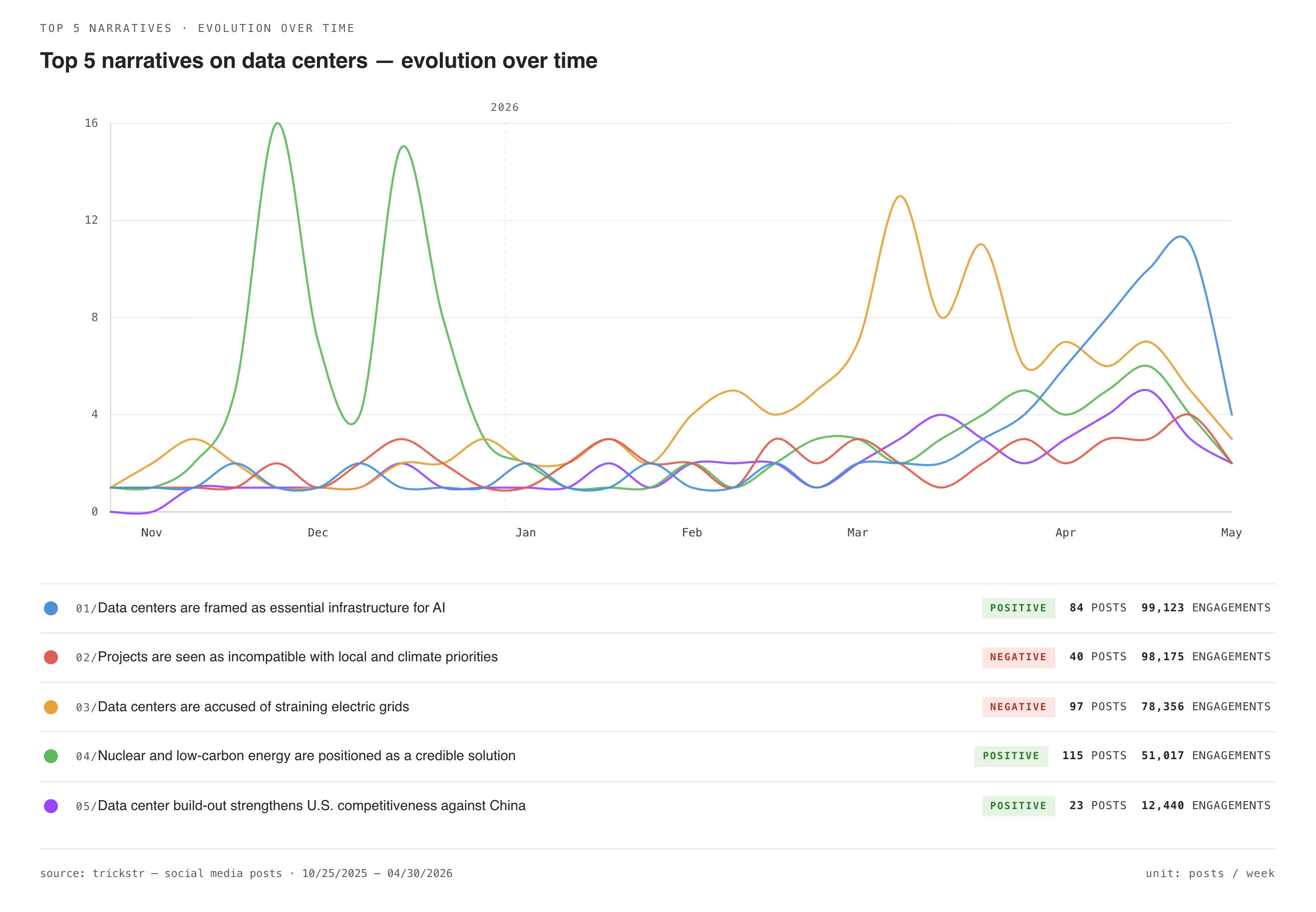
The prosperity axis: a pro-business and nationalist vision
Supporters of data centers, mainly from business circles, the tech industry, and the political right, defend a vision in which the development of these infrastructures is a non-negotiable imperative. The central argument is that without massive compute capacity, the United States will lose its technological and economic leadership. This perspective justifies the colossal investments and presents negative externalities as technical challenges to be overcome rather than as outright obstacles. Job creation and tax revenue are systematically highlighted to convince local communities to accept projects that might otherwise be perceived as a nuisance.
The justice axis: an environmental and social critique
Opponents, made up of coalitions of residents, environmental activists, and largely left-wing elected officials, contest this development model. Their main argument is that data centers concentrate benefits in the hands of a few multinational corporations while pushing the costs onto the community. They denounce a “Faustian bargain” in which often overstated job promises are exchanged for a degradation of natural resources, pressure on public services (water, electricity), and a rise in the cost of living. The demand for regulation, moratoriums, and greater transparency aims to rebalance this power dynamic and ensure that projects are not built at the expense of the general interest.
Conclusion: the AI race put to the test of the social contract
The spectacular expansion of data centers in the United States has stopped being a mere technological question to become a top-tier political and social issue. The confrontation is total between a national vision that makes AI supremacy an absolute priority and a local reality in which the environmental, social, and financial costs of this ambition are becoming increasingly tangible.
The analysis of media and political discourse reveals a profound polarization, largely aligned with traditional partisan divides. On one side, a pro-business, Republican coalition defends a model of accelerated growth, justified by international competition and the promise of economic benefits. On the other, an alliance of Democratic elected officials, citizens, and environmental activists demands stricter regulation in the name of environmental justice and consumer protection.
Beyond technology, it is indeed the social contract between digital giants and American society that is being redefined. Emerging legislative initiatives and the multiplication of local conflicts show that laissez-faire is no longer a viable option. The question is no longer whether data centers should be built, but how, at what price, and according to what rules. The ability of the United States to reconcile its technological ambition with the imperatives of social cohesion and environmental sustainability will be one of the major challenges of the decade to come.
Take it further
To access the interactive version of this analysis, receive intelligence reports tailored to your stakes, or see a demo of our analysis and simulation products, get in touch.
Benjamin Merritt, Trickstr Co-founder : bmerritt@trickstr.ai (mailto:bmerritt@trickstr.ai)